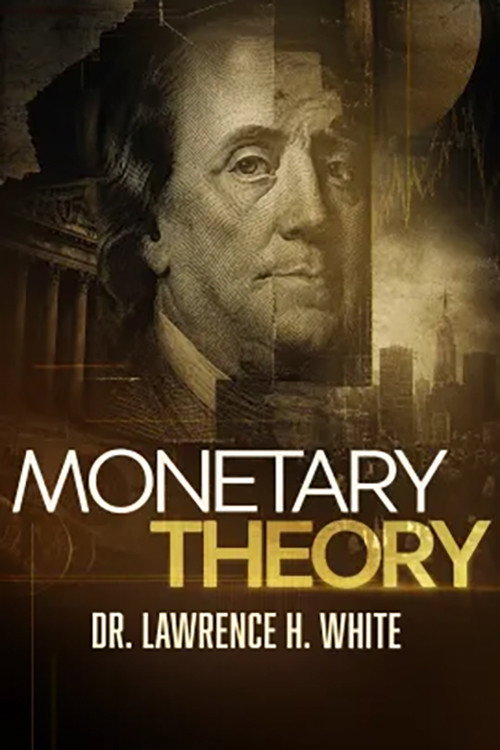
Monetary Theory

Monetary Theory

2026
DocumentaryTalk

In Monetary Theory, a nine-hour course, Dr. Lawrence White explores the debate between market-based and government-controlled monetary systems, combining theory with historical evidence from gold standards to modern fiat currencies. We examine how money can emerge through market forces, the mechanics of fractional-reserve banking, and how central banks influence inflation. The course also addresses banking stability, market failure arguments, and the causes of inflation, including seigniorage. It concludes by evaluating monetary policy rules, inflation targeting, and alternatives like Bitcoin, and asks whether sound money requires commodity backing or if proper institutional design can achieve stability in fiat systems.

Production

Peterson Academy

Language

EN

Status

Ended

First Aired

March 3, 2026

Last Aired

March 3, 2026

Created By

Lawrence H. White

Where to Watch
Region US · Lang EN
US
No providers available for this region.
Available in Your Library
Seasons & Episodes
Select a season to view episodes. Reddit links may contain spoilers.
Season
E1
Money: Private or Public?
Air date: 2026-03-03
In our introductory lecture, Dr. White delves into monetary theory by examining the fundamental question of whether markets or governments should provide money, drawing on historical and theoretical perspectives on monetary systems. Together, we analyze Carl Menger's market theory of money, which explains how money emerges naturally from barter between individuals, contrasting this with the state theory that claims government intervention is necessary for monetary systems to function. Dr. White highlights 19th-century American private mints during gold rushes as evidence that market forces can produce trustworthy money without government involvement. Finally, we see that government monopolies often lead to debasement for revenue, and that private systems remain relevant to modern debates on digital currencies.
E2
The Gold Standard
Air date: 2026-03-03
In lecture two, we learn about the mechanics of a gold standard, focusing on how supply and demand for monetary gold determine money’s quantity and purchasing power. Dr. White explains the system’s self-correcting mechanism, where changes in demand spur adjustments in gold mining, restoring equilibrium and supporting long-run price stability. Comparing gold and fiat systems, the lecture highlights historically lower inflation, greater price predictability, and stronger fiscal discipline under gold. Finally, we review common objections about gold resource costs and consider why economists today generally oppose returning to a gold standard.
E3
Free Banking
Air date: 2026-03-03
In lecture three, we examine banks’ role in issuing money under a gold standard, explaining why people prefer banking services to direct gold transactions and what constrains banks without legal limits. We explore fractional-reserve banking as a voluntary system where banks provide payments and interest while lending a portion of deposits. The lecture concludes by showing how market forces—adverse clearings, reserve losses, and the price-specie flow mechanism—naturally limit money creation, allowing competitive banking systems to self-regulate without central bank oversight.
E4
The Fiat Standard
Air date: 2026-03-03
In lecture four, we explore fiat money—currency created by government decree rather than commodity backing—tracing its rise after wartime suspensions of the gold standard and the shift to central bank control of the money supply. We examine the quantity theory of money, showing that increases in money supply drive price levels and make central banks responsible for inflation. The lecture concludes that institutions like the Federal Reserve control inflation through monetary policy, challenging alternative explanations such as deficits or “greedflation” as primary causes of inflation.
E5
Government in Money
Air date: 2026-03-03
In lecture five, we consider whether government intervention in monetary services improves public welfare, using concepts like market failure and Pareto efficiency. We evaluate public goods, externalities, and natural monopoly arguments, finding little support for intervention since money is largely rival and excludable, and network effects are typically internalized by markets. The lecture concludes with Friedman’s optimum quantity of money theory, which advocates mild deflation to reduce the cost of holding money and maximize welfare, though such policies have proven impractical in practice.
E6
Bank Fragility
Air date: 2026-03-03
In lecture six, we analyze arguments for government involvement in banking, particularly the claim that unrestricted banking is inherently unstable and prone to runs. We explore the Diamond-Dybvig model that justifies deposit insurance, contrasting random panic theories with "bad news" explanations for runs. Dr. White concludes that well-capitalized, diversified banking systems—like Canada’s—are stable, and that U.S. instability stemmed from legal restrictions, leading to the Federal Reserve as a political compromise rather than an economic necessity.
E7
Money Making
Air date: 2026-03-03
In lecture seven, we study the underlying causes of money growth and inflation, examining why central banks issue more money than is consistent with stable purchasing power. We delve into the concept of seigniorage—the profit from money creation—tracing its historical roots from medieval mints that debased coins to modern fiat money systems where governments can finance spending by printing currency. The lecture analyzes how governments facing fiscal pressures, particularly during crises, may resort to excessive money printing, potentially leading to hyperinflation, and discusses the growing U.S. debt-to-GDP ratio and its implications for future monetary policy and inflation risk.
E8
How to Secure Better Money
Air date: 2026-03-03
In our eighth and final lecture, we discuss the challenges of maintaining sound money in a fiat monetary system and examine potential solutions to prevent fiscal problems from undermining the dollar's purchasing power. We delve into the debate over central bank rules versus discretion, analyzing why monetary policy cannot permanently reduce unemployment or boost real economic growth. Dr. White concludes our course by evaluating various monetary policy targets, including inflation targeting versus nominal GDP targeting, and considers alternative approaches such as Hayek's proposal for competitive currencies and the potential role of Bitcoin as a monetary standard.

Cast

Lawrence H. White

Lawrence H. White

Host

Recommended

WWE 24
Checking...

WWE 24

2015
6.8
Quarterback
Checking...

Quarterback

2023
8.0
Buzzfeed Unsolved: Supernatural
Checking...

Buzzfeed Unsolved: Supernatural

2016
8.5
Biography
Checking...

Biography

1987
6.7
History 101
Checking...

History 101

2020
7.1
Mind Field
Checking...

Mind Field

2017
8.2
Top Gear
Checking...

Top Gear

1978
8.0
Last Chance U
Checking...

Last Chance U

2016
7.2
Hulk Hogan: Real American
Checking...

Hulk Hogan: Real American

2026
7.5
How Do They Do It?
Checking...

How Do They Do It?

2006
7.5
30 for 30
Checking...

30 for 30

2009
7.5
Eli Roth's History of Horror
Checking...

Eli Roth's History of Horror

2018
6.4

Similar TV Shows

Ancient Megastructures

Checking...

Ancient Megastructures

2011
8.5
Gåden om Thyra
Checking...

Gåden om Thyra

2023
10.0
Martin Clunes: Islands Of Britain
Checking...

Martin Clunes: Islands Of Britain

2009
7.3
Epic History TV
Checking...

Epic History TV

2015
Sydney Gay and Lesbian Mardi Gras
Checking...

Sydney Gay and Lesbian Mardi Gras

1994
Vasa: The Ghost Warship
Checking...

Vasa: The Ghost Warship

2023
8.0
Indonesia Merdeka!
Checking...

Indonesia Merdeka!

1976
Guided Tour
Checking...

Guided Tour

2014
Uniform, Macht, Mode
Checking...

Uniform, Macht, Mode

2025
Great Minds Think for Themselves
Checking...

Great Minds Think for Themselves

1997
3.3
History's Verdict
Checking...

History's Verdict

2013
6.5
Once Upon a Time... Life
Checking...

Once Upon a Time... Life

1987
7.8
PickFlick Assistant
Hi! I'm your PickFlick Assistant. Ask me about movies, TV shows, OTT sources, or anything about PickFlick.

Powered by CopilotKit